


PVC injection molding helps make tough and detailed plastic parts. It works by pushing melted PVC into a mold with a special shape. First, you dry the PVC. Then, you mix in other materials. After that, you set the machine’s temperature and pressure. Companies use this method because it makes exact parts. These parts are used in building, medical, and car industries.
| Aspect | Detail |
|---|---|
| PVC Market Share (Dry Segment) | 60% of revenue in 2024 |
| Injection Molding Growth | Fastest at about 5.8% each year (2025-2032) |
| Key Application Sectors | Building, electrical, car, medical |
You must follow every step closely. PVC changes a lot with heat and water. This makes PVC injection molding special compared to other ways of making plastic.
Key Takeaways
- PVC injection molding forms melted PVC into exact parts. These parts are used in many fields like building, health, and cars. Drying PVC resin well before molding stops problems. It also helps parts stay strong and last longer. Keeping the right heat and pressure during molding stops bad gases. It also makes sure the parts are good quality. PVC parts can stand up to chemicals, fire, and water. This makes them last long and work well for hard jobs. A good mold design and cleaning machines often make better parts. This also saves time and money.
PVC Material
What Is PVC
PVC stands for polyvinyl chloride. It is a type of plastic made by joining vinyl chloride molecules. PVC comes in two types: rigid and flexible. Rigid PVC is strong and keeps its shape well. Flexible PVC bends easily because it has plasticizers. You can use PVC for pipes, window frames, cables, and medical devices. PVC is special because it does not let water, chemicals, or fire damage it. You can recycle PVC to help the environment.
Tip: You can pick different additives to change how PVC acts. Additives like stabilizers, lubricants, and impact modifiers help you get the right mix of strength, flexibility, and safety for your project.
Key Properties
PVC has many features that make it good for making things. Here are some important facts:
- PVC has a high density of about 1.38 g/cm³. This makes it heavier than many other plastics.
- It has great tensile strength and hardness. Your parts stay tough and rigid.
- PVC resists chemicals, fire, and abrasion. It lasts longer in harsh places.
- You can make PVC rigid or flexible by adding plasticizers and other additives.
- PVC melts between 338°F and 410°F. It starts to lose shape above 140°F.
- It does not soak up moisture. PVC works well in wet places.
- PVC is a good electrical insulator. It is safe for wires and cables.
- You can recycle PVC and use it again without losing quality.
Here is a table that shows some key properties:
| Property Category | Property | Description / Range |
|---|---|---|
| Mechanical | Tensile Strength at Yield | 3.45 to 73.1 MPa; shows how much load it can handle |
| Mechanical | Elongation at Break | 2% to 330%; shows flexibility and stretch |
| Mechanical | Flexural Modulus | 0.220 to 6.43 GPa; shows stiffness |
| Mechanical | Flexural Yield Strength | 50.7 to 104 MPa; shows resistance to bending |
| Thermal | Heat Deflection Temperature | Deforms above ~82°C (180°F) |
| Thermal | Operating Temperature | Up to 60°C (140°F); higher heat can cause damage |
| Chemical | Chemical Resistance | Stands up to many acids, bases, salts, and alcohols |
| Chemical | Degradation Products | Overheating can release hydrochloric acid (HCl) |
Note: You should keep PVC out of too much sunlight. UV rays can make it yellow or weaker over time. Painting or coating can help stop this.
PVC Injection Molding Process
Material Preparation
You need to start with careful material preparation to get the best results from PVC injection molding. Drying the PVC resin is very important. If you skip this step or do it poorly, moisture stays in the resin. This moisture can break the polymer chains during molding. When this happens, your parts lose strength, become brittle, and may not resist chemicals as well. You might also see bubbles, streaks, or even cracks in the finished product.
To avoid these problems, always dry the PVC resin until the moisture level is below 0.1%. Use tools like gravimetric analyzers or sensor-based systems to check moisture. The right drying temperature is usually between 60°C and 80°C for 2 to 4 hours. Additives and fillers can change how much moisture the resin holds, so you must adjust your drying process if you use them.
Tip: Follow the resin manufacturer’s drying guidelines. This helps you keep the PVC strong and stable during molding.
Injection and Molding
Once you prepare the material, you move to the injection and molding stage. Here, you heat the PVC to a temperature between 345°F and 375°F (about 160°C to 190°C). You must control the temperature very closely. If the temperature goes too high, PVC starts to break down. This breakdown releases hydrogen chloride gas and other toxic chemicals. These byproducts can harm both people and the environment.
PVC is more volatile than many other plastics. The plasticizers in PVC can evaporate or move to the surface when you heat the material. This makes the process tricky. You need to watch the temperature and pressure at all times. Modern machines use sensors and online tools to help you keep everything steady. You should also design your molds with cooling channels to spread the heat evenly.
Here are some risks you face if you do not control the process:
- PVC can start to decompose at about 135°C, releasing harmful gases.
- Toxic byproducts like dioxins and HCl can form, which are dangerous to health.
- PVC dust can cause serious health problems, including cancer.
To keep your machine clean and avoid contamination, you should use special purging compounds. These compounds remove leftover PVC from the machine. You should purge the machine often, not just when you see a problem. This keeps your parts clean and reduces downtime.
Best practices for purging:
- Use high-performance purging compounds made for PVC.
- Purge the machine before you see contamination.
- Watch your production data to know when to purge.
- Use only as much purging compound as you need.
- For tough cases, use special compounds to clean the screw and barrel quickly.
Note: Good purging can cut contamination costs by up to 65% and save you hours of cleaning time.
Cooling and Ejection
After you inject the PVC into the mold, you need to cool the part before you remove it. Cooling is the longest part of the cycle. The time it takes depends on the thickness of your part and the material of your mold. Molds made from copper alloys cool faster than steel molds. If your part is thick, it will take longer to cool.
You should design your molds with cooling channels to help spread the temperature evenly. This reduces warping and bending. If you control the cooling well, your parts will look better and last longer.
The total cycle time for PVC injection molding includes injection, cooling, and mold opening. Cooling usually takes the most time. If you use the right mold materials and design, you can make the process faster and more efficient.
Tip: Always monitor the temperature during cooling. This helps you avoid defects and keeps your production running smoothly.
Advantages and Disadvantages
PVC Injection Molding Advantages
PVC injection molding has many good points:
- Parts made this way can handle weather and sunlight. This helps when making car parts or things for outside.
- You save money if you make lots of parts at once. The process is great for making many items quickly.
- You can make shapes that are tricky or have small details. The molds help you get the right size and shape.
- The parts are strong and last a long time. PVC does not get ruined by chemicals, fire, or wearing out.
- You can add things to change how PVC works. This lets you use it for many different jobs.
- The process gives you the same part every time. You can trust the quality will not change.
Many companies pick injection molding. It is good for making lots of parts and works with many types of materials.
Here is a table that shows how much different plastics cost and what they need:
| Material Category | Typical Cost (USD/kg) | Processing Temperature (°C) | Key Considerations and Properties |
|---|---|---|---|
| Commodity Plastics | $1 – $2 | N/A | Cheap, easy to use, good for things you throw away or use at home. |
| Engineering Plastics | $3 – $6 | N/A | Costs more, handles heat and wear better, used for strong parts. |
| PVC (Polyvinyl Chloride) | N/A | 160 – 210 | Can be used in many ways, resists chemicals and fire, needs careful temperature control. |
Disadvantages
There are also some problems with PVC injection molding:
- You must pay a lot to make the mold at first. This is not good if you only need a few parts.
- If you want to change the mold or design, it takes a long time and costs more.
- Some shapes are hard to make, like inside threads or parts that stick out. You might need extra work to finish these.
- The process makes waste, like extra bits of plastic. Sometimes you cannot use this waste again.
- You need more energy to heat and cool the molds. This can make your costs go up.
- The size of the part depends on the mold and machine. Very big parts are hard to make.
- If you need very exact sizes or special materials, other ways like CNC machining might be better.
Think about how many parts you need, your design, and your budget before you pick PVC injection molding.
Design Tips
Mold Design
When you make a mold for PVC injection molding, you have to think about a few key things. PVC can wear out molds fast, so you should use strong metals like P20 or H13 tool steel. These metals help your mold last longer and stop it from breaking down. Add draft angles to your mold. Draft angles help you take out the parts without breaking them. Good ventilation lets air out, so the parts fill up right and look smooth.
A good cooling system is very important. Cooling channels help spread heat and stop the parts from bending. You also need to choose the right gate type and size. This helps the melted PVC move well and keeps weld lines away. Check your screw speed and backpressure often. If you control these, you can stop the PVC from getting too hot and making bad parts.
| Mold Class | Life Expectancy (Cycles) | Material Quality | Typical Applications | Maintenance & Cost Considerations |
|---|---|---|---|---|
| Class 101 | Over 1,000,000 | Premium hardened steel with heat treatment | High-volume, high-precision industries (automotive, aerospace, medical) | Needs lots of care; costs more at first but saves money later |
| Class 102 | Up to 500,000 | High-grade steel | Medium to high volume production (consumer electronics, automotive components) | Needs regular care; good balance of cost and strength |
| Class 103 | Up to 100,000 | Quality but less hardened steel | Lower volume or prototype production | Easier design; saves money for short jobs |
Tip: Try using CAD/CAM software and FEA tools before you build your mold. These tools help you find problems early and save money.
Processing Guidelines
You need to keep your machines and molds clean when working with PVC. Special purging compounds work better than just using new resin. These compounds clean out old PVC, color, and carbon. They help you stop black spots and other problems in your parts. Cleaning often also means less downtime and saves you money.
Safety is very important. Never mix PVC with other plastics like acetal. Even a little bit can make dangerous gases. Always wear safety glasses, gloves, and a mask if you need one. Make sure your workspace has good airflow. Teach everyone on your team to follow safety rules and know what to do if something goes wrong.
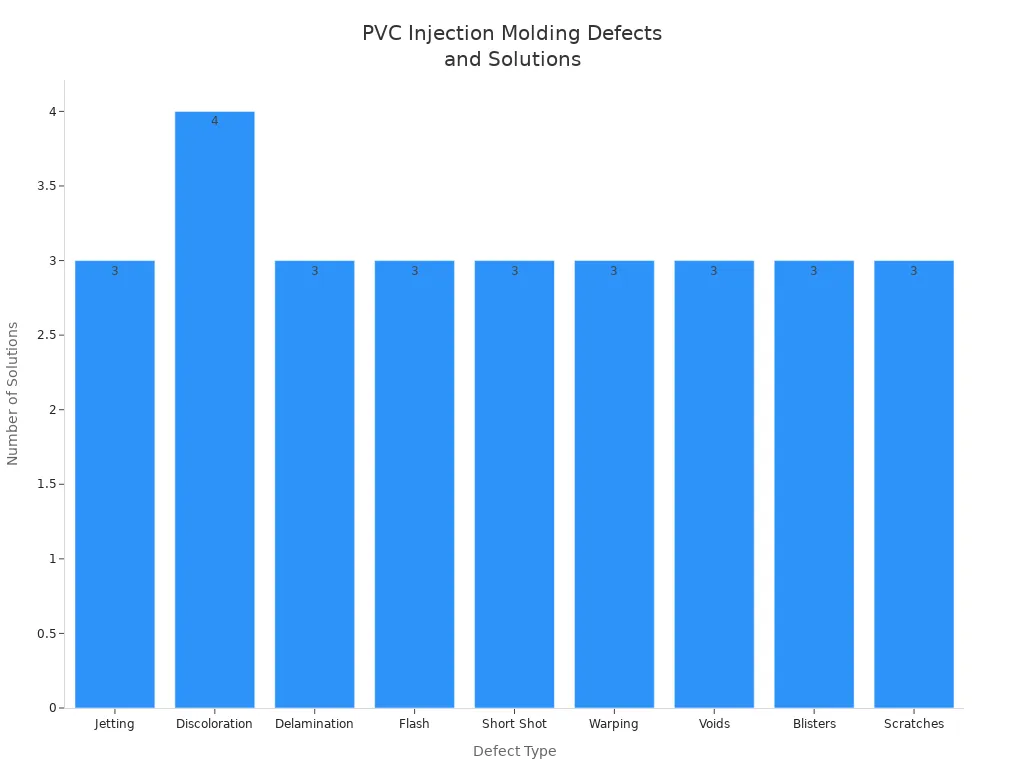
You can see common problems and how to fix them in the chart below:
Note: Cleaning and checking for safety often helps you make better parts and keeps your team safe.
Applications
Common Uses
You see PVC products all the time. Many companies use PVC for food and drink packaging. It is in bottle caps and snack containers. These items are strong and safe. They are easy to make into different shapes. The packaging industry uses lots of injection molded plastics. This is because people buy more things online. Fast-moving goods also need lots of packaging. In 2022, the global market for injection molded plastics was $337.8 billion. Experts think it will be over $500 billion by 2031. Asia Pacific countries make and use the most packaging from PVC and other plastics.
PVC helps companies make many items you use once, like cups and trays. Its strength and flexibility make it a popular choice.
Industry Examples
PVC parts are used in many industries. Each industry picks PVC for different reasons. The table below shows some examples:
| Industry | Notable PVC Injection Molded Components and Applications |
|---|---|
| Medical | IV bags, tubing, medical devices |
| Construction | Pipes, fittings, window seals, gaskets, plumbing fittings, electrical enclosures, HVAC parts, door handles |
| Automotive | Interior parts such as dashboards, door panels, seat bases, trim pieces |
| Consumer Goods | Footwear, phone cases |
| Oil and Gas | Seals, gaskets, valves, protective covers |
| Transportation | Dashboards, bumpers, light housings, aerospace and rail system parts |
| Pest Control | Bait stations, traps, sprayers, pest barriers (door seals, window protections) |
| Marine | Boat parts (seats, storage bins, hatches, navigation housings), fishing gear (tackle boxes, bait containers) |
| Filtration | Filter housings, filter media supports, valves, pressure regulators |
PVC is important for making parts for buildings, cars, and boats. It is also used for medical tools. PVC lasts a long time and resists chemicals. This makes it good for tough jobs. You also see PVC in things like shoes and phone cases.
PVC injection molding helps make tough and detailed parts. Many industries use it. You must be careful with the materials. Each step in the process needs close control. This method is good if you want parts that resist chemicals or fire. It also works well for making lots of parts fast.
- People in construction, medical, and packaging use this process. They like it because the parts last long and save money.
If your project is tricky, ask experts for help. You can also learn more to pick the best technology for your needs.
FAQ
What makes PVC injection molding different from other plastics?
You must control temperature and moisture very carefully with PVC. If you overheat PVC, it can break down and release harmful gases. You also need to keep your machines clean to avoid contamination.
Can you recycle PVC parts made by injection molding?
Yes, you can recycle PVC parts. You can grind old parts into small pieces and use them again in new products. This helps you save money and protect the environment.
Is PVC injection molding safe for food or medical products?
You can use special grades of PVC for food and medical items. These grades meet strict safety rules. Always check that your PVC resin is approved for your product’s use.
How do you avoid defects in PVC molded parts?
You should dry the resin well and keep your machines clean. Use the right temperature and pressure settings. Good mold design also helps you make strong, smooth parts.
What are common problems when molding PVC?
You may see bubbles, burns, or color streaks if you do not control moisture or temperature. Sometimes, parts can warp or crack. Careful setup and regular cleaning help you avoid these issues.
