


PVC injection molding applications are widespread across many industries in 2025. Key sectors include packaging, building, healthcare, automotive, electronics, consumer goods, and transportation. Manufacturers prefer PVC because it is durable and long-lasting, resistant to chemical damage, flexible, and cost-effective. In the automotive industry, PVC injection molding applications include producing exterior parts like bumpers and covers, as well as interior components such as dashboards and storage boxes. These qualities make PVC a favored material for a variety of products.
Key Takeaways
- PVC injection molding is used in many fields like medical, construction, cars, home goods, electrical, and traffic safety. PVC products last a long time and do not get damaged by chemicals easily. They can be soft or hard to fit different uses. PVC does not cost much and is simple to shape. This helps companies make many things fast and for less money. New technology makes PVC molds last longer and products work better. It also saves energy. Recycling and safer designs help the environment and make the future greener.
PVC Injection Molding Applications
Medical
PVC injection molding is very important in medicine. Hospitals and clinics use many PVC products. These include:
- IV and blood bags
- Catheters
- Mattresses and examining tables
- Medical gloves
- Feeding devices
- Supply packaging
- Patient ID bracelets
- Thermal blankets
- Respiratory therapy equipment
- Dialysis equipment
- Inflatable splints
PVC can be hard or soft. This helps make devices with both types of parts. It is easy to recycle and design. PVC is safe for people and works well with blood. It does not get damaged by chemicals. It keeps its shape with different liquids and medicines. PVC can be cleaned with steam or radiation. It stays strong and flexible after cleaning. PVC is not expensive. This helps hospitals make lots of medical items.
Construction
Builders use pvc injection molding for many building parts. Some common items are:
- Window frames
- Insulation materials
- Plumbing components
- Lighting fixtures
- Decorative elements
- Pipes and fittings
- Weather-resistant siding
RPVC is strong and lasts a long time. It is good for pipes and window frames. PVC does not get damaged by weather. It does not soak up water, so it does not rot. It does not rust, even in wet or salty places. PVC does not fade or bend in the sun. Builders like it because it is easy to care for. It does not break easily and lasts for years. PVC is light, so it is easy to move and install.
Automotive
Car makers use pvc injection molding for many car parts. These include:
- Bumpers
- Dashboards
- Door panels
- Storage boxes
- Cable insulation
- Seals and gaskets
PVC bends without breaking. This helps protect people in crashes. It does not get ruined by oil or cleaners. PVC lasts a long time in hot or cold weather. It works inside and outside the car. PVC is cheap and can be shaped into many forms. This helps make new car designs.
Consumer
Many everyday things use pvc injection molding. Some examples are:
- Toys and inflatable items
- Shower curtains
- Garden hoses
- Footwear soles
- Packaging films and sheets
Flexible PVC is strong but not heavy. It does not wear out fast. It does not get ruined by chemicals or weather. Makers can change how soft PVC is. This helps make different products. PVC is cheaper than rubber. It is good for making fun and useful things.
Electrical
PVC injection molding is important for electrical items. Some main products are:
- Electrical housings
- Cable insulation
- Switch boxes
- Conduit pipes
PVC can handle high voltage safely. It does not let electricity pass through. It does not get damaged by water or chemicals. PVC stays strong when it gets hot or is pressed. It bends without breaking, which helps with wires.
Industrial
Factories use pvc injection molding for tough jobs. Some products are:
- Chemical processing tanks
- Water treatment components
- Industrial piping and fittings
- Valves and seals
PVC does not get ruined by strong chemicals. It is good for moving acids, alkalis, and oils. Its smooth surface stops things from sticking inside pipes. This is good for food and water systems. PVC pipes can last up to 100 years. They do not need much fixing.
Traffic and Road
PVC injection molding helps keep roads safe. Many road safety items use PVC. Some examples are:
| Product Type | Height (mm) | Base Size (mm) | Weight (kg) | Special Features |
|---|---|---|---|---|
| PVC Traffic Cone | 300 | 210×210 | 0.6 | Standard cone |
| PVC Traffic Cone | 450 | 280×280 | 1.1 | Standard cone |
| PVC Traffic Cone | 700 | 360×360 | 1.8 / 2.3 | Standard cone |
| PVC Traffic Cone | 900 | 360×360 | 4.2 | Standard cone |
| Interlock PVC Traffic Cone | 450 | 280×280 | 1.6 | Interlocking design |
| Interlock PVC Traffic Cone | 700 | 360×360 | 3.3 | Interlocking design |
| Interlock PVC Traffic Cone | 900 | 360×360 | 4.2 / 5 / 5.5 | Interlocking design |
Other items are:
- Barricades for pedestrian routes and events
- Barrier reflectors
- Channelizer posts and flexible bollards
- Flexible sign systems
- Parking lot signposts
PVC cones and barriers are bright and easy to see. They do not get damaged by sun, hits, or rain. They are light, so people can move them easily. PVC cones may wear out, but they are still useful. They are good for short-term use and events.
Benefits of PVC Injection Molding
Durability
PVC injection molding makes things that last a long time. Many companies pick PVC because it does not wear out fast. Molds can make 100,000 to 500,000 parts before they need to be replaced. How long a mold lasts depends on what it is made of, its shape, and how people take care of it. Some molds, like S136 steel, do not rust and last longer. Cleaning and storing molds the right way helps them work for more years. PVC products stay strong even in hard places. They do not break when it is hot, cold, or used a lot. Most PVC items do not need much extra work after molding, so this saves time and money.
Tip: If you store molds in a climate-controlled room, they can last about 20% longer.
- High density and strength
- Great at resisting scratches and scrapes
- Keeps its shape well
- Lasts a long time inside and outside
Chemical Resistance
PVC is very good at standing up to many chemicals. This is why it is used in medical, industrial, and building products. The table below shows how PVC does compared to other plastics:
| Plastic | Chemical Resistance Characteristics |
|---|---|
| PVC | Stands up well to acids, alkalis, salt water, and most solvents; only dissolves in strong polar solvents like ketones and esters. |
| PP | Good with acids and alkalis; can be hurt by some chemicals. |
| ABS | Okay with some chemicals; can be damaged by certain liquids. |
| PE | Good with many chemicals but not with oils. |
PVC does better than ABS and PE with acids, alkalis, and salt water. It works as well or better than PP in many places with chemicals. This makes PVC great for pipes, tanks, and medical tools that need to handle strong substances.
Flexibility and Versatility
PVC is very flexible and can be used in many ways. Makers can change how it acts by adding special ingredients. They can make PVC hard or soft. Hard PVC is good for pipes, window frames, and sheets. Soft PVC is used for toys, medical tubes, and fake leather.
Note: PVC can be made into shapes with small details, so designs can be very exact.
- Many choices for strength, flame resistance, and lasting a long time
- Works with different ways of making things, like extrusion and bonding
- Good for making lots of items quickly
- Can look shiny, have pictures, or have different textures
PVC fits many jobs. It is used in building, health care, cars, and things people use every day. This helps makers come up with new ideas and make better products.
Challenges and Alternatives
Processing Issues
PVC injection molding can be tricky for workers. They must do each step right to stop mistakes and make good products. First, workers dry the PVC resin at about 60°C for 2–3 hours. This keeps water from causing problems. Next, they keep the melt temperature between 170°C and 190°C. If it gets too hot, PVC can break down and make bad gases. Workers also watch the injection pressure. It should be between 80 and 120 MPa. This helps fill the mold the same way each time. Cooling the mold is important too. The time needed depends on how thick the part is. Good cooling stops the part from bending. Workers use anti-stick sprays or mold release agents. These help finished parts come out of the mold easily.
New machines and tools help fix these problems. Direct Metal Laser Sintering (DMLS) makes molds with special cooling lines. These lines help molds last longer and work faster. Computers and smart machines help set the best molding steps. These tools make better products and use less energy.
| Processing Issue | Solution / Advancement | Details / Parameters |
|---|---|---|
| Moisture Control | Dry PVC pellets to reduce moisture content | Target moisture: 0.3% at 24-32°C to avoid cosmetic defects |
| Temperature Control | Precise temperature management to prevent degradation | Melting temp up to 195°C; mold temp between 20°C and 60°C |
| Injection Pressure | Maintain optimal injection pressure | 20-40% of max allowable pressure; back pressure 0.4-0.7 MPa |
| Injection Speed | Moderate injection speeds tailored to part geometry | Slower speeds for thicker parts to avoid surface defects |
Environmental Concerns
PVC injection molding can hurt the environment and health. Making and throwing away PVC makes dirty water and pollution. Burning or burying PVC lets out dangerous chemicals like heavy metals. The whole life of PVC can cause air and water pollution, acid rain, and global warming. Breathing in PVC dust can hurt lungs and may cause cancer. Tiny plastic pieces from PVC can poison fish and mess up nature. Gases from burning PVC are very bad for people and animals.
Many countries now have recycling programs for PVC. Groups like +Vantage Vinyl, Recovinyl, and the PVC Stewardship Program help recycle more and lower harm. These groups help control waste and keep nature safe.
Alternative Materials
Sometimes, makers pick other plastics instead of PVC. Each type has good and bad points. Some plastics like PPS and PET can handle heat and chemicals better than PVC. But they cost more and need hotter machines. HDPE and PP are stronger when hit and cost less to mold. They also let factories make things faster.
| Property | PVC (Rigid) | HDPE | PP | ABS |
|---|---|---|---|---|
| Tensile Strength | 40-55 MPa | 22-30 MPa | 30-40 MPa | 40-50 MPa |
| Impact Strength | 2-5 kJ/m² | 20-100 kJ/m² | 2-10 kJ/m² | 15-40 kJ/m² |
| Flexural Modulus | 2.5-3.5 GPa | 1.0-1.5 GPa | 1.5-2.5 GPa | 2.0-3.0 GPa |
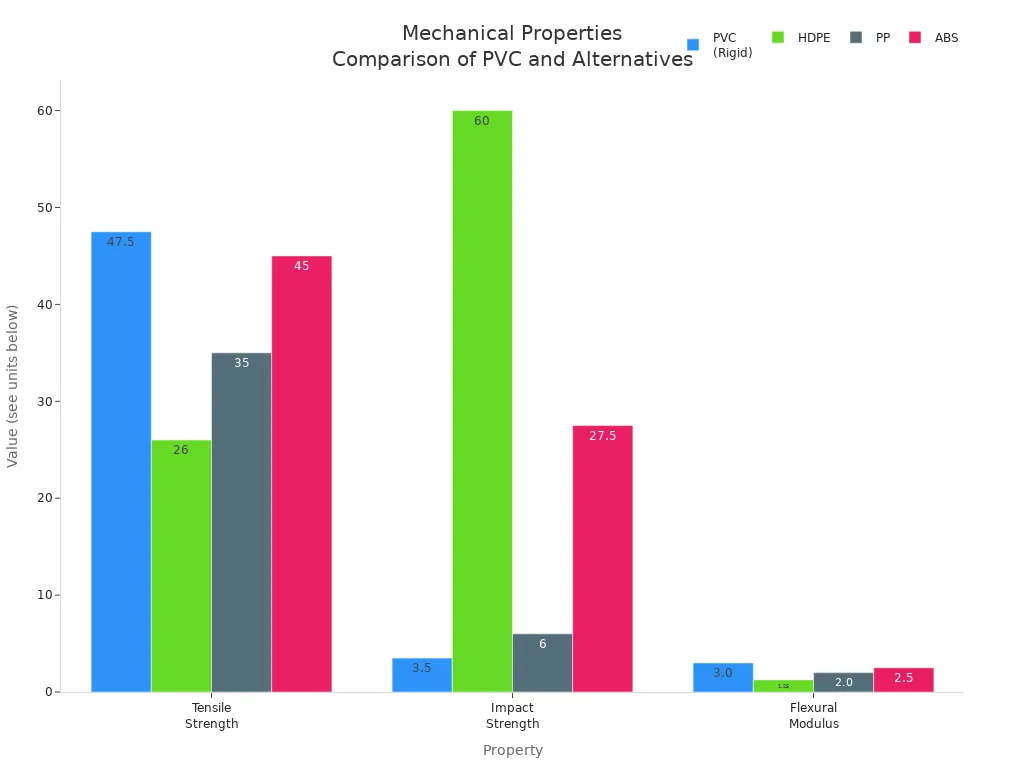
For big jobs, HDPE can save money because it does not wear out molds fast and makes parts quickly. Still, PVC is strong and stands up to chemicals for less money in many cases.
PVC injection molding is important for many industries in 2025. Construction, medical, automotive, consumer, and electrical fields use PVC a lot. They like it because it lasts long, stands up to chemicals, and saves money.
- Makers use smart robots, machines that save power, and better materials.
- Big companies think the industry will keep growing. New technology helps make things faster and better.
- Rules for the environment and what people want push companies to make greener products.
Getting the most from PVC means using good controls and smart designs. Experts think the market will grow a lot. PVC injection molding will change to fit what people need next.
FAQ
What makes PVC injection molding popular in 2025?
PVC injection molding is still liked in 2025. It makes products that are strong and bend easily. These products do not cost a lot to make. Many companies use PVC because it does not get ruined by chemicals. PVC items last a long time. Factories can make many shapes with PVC. This helps them make lots of things fast.
Is PVC safe for medical and food applications?
Doctors and food makers use special PVC. This PVC does not react with most chemicals. It follows strict safety rules. Hospitals use PVC for blood bags and tubes. Food packaging uses PVC that keeps food safe and fresh.
Can people recycle PVC products?
Yes, people can recycle many PVC things. There are programs that collect old PVC. Workers turn used PVC into pipes, floors, or traffic cones. Recycling PVC helps cut down on trash. It also helps keep nature clean.
How does PVC compare to other plastics like HDPE or ABS?
PVC stands up to chemicals better than ABS and HDPE. It is cheaper than many other plastics. HDPE is stronger when hit, but PVC lasts longer in tough places. Factories pick the right plastic for each product.
