


Nylon injection molding makes strong and tough parts. It does this by pushing melted nylon into a mold. Manufacturers pick nylon because it has great mechanical and physical properties. This process is special because it can make tricky shapes with high accuracy. Nylon has high crystallinity, low melt viscosity, and good abrasion resistance. These features make nylon perfect for tough jobs.
| Property | Benefit for Injection Molding |
| High Crystallinity | Makes parts stronger and last longer |
| Low Melt Viscosity | Helps make thin walls and tricky shapes |
| Abrasion Resistance | Makes parts last longer when they rub a lot |
| High-Temperature Resistance | Lets parts work up to 150°C |
| Flexibility and Resilience | Lets parts bend and snap back easily |
Nylon injection molding gives good results for both easy and hard designs.
Key Takeaways
- Nylon injection molding creates strong parts. It pushes melted nylon into molds. The process uses careful heat and pressure control.
- Always dry nylon pellets before molding. This stops weak spots and defects from moisture.
- Keep wall thickness the same everywhere. Use the right draft angles. This helps molding go smoothly and lowers part defects.
- Pick the correct nylon grade for your part. Filled nylons make parts stronger and more stable. They also help parts resist heat and wear.
- Use careful machine settings and good mold design. Check quality often. This helps stop problems like warping, sink marks, and short shots.
Nylon Injection Molding Basics
What Is Nylon Injection Molding
Nylon injection molding shapes nylon into exact parts with a mold. First, the nylon pellets must be dried to take out water. This step stops problems from happening later. The pellets melt inside a hot barrel. The machine pushes the melted nylon into the mold using high pressure. After the mold fills, the machine keeps pressure on it. This helps stop shrinking and makes the part better. The mold’s temperature is watched closely. This changes how strong and shaped the part will be. Sometimes, release agents are used to help get the part out. When the part cools and gets hard, it comes out of the mold.
Tip: Always dry nylon before molding. If nylon is wet, the part can be weak or have marks.
Main steps in nylon injection molding:
- Dry the nylon to get rid of water.
- Melt the nylon pellets in the machine.
- Push the melted nylon into the mold.
- Hold pressure to stop shrinking.
- Control the mold’s heat for best results.
- Use release agents if needed.
- Take out the cooled part from the mold.
Nylon injection molding is different from other plastics. Nylon needs careful heat control and special care after molding. Nylon melts at a high temperature and soaks up water. This makes it different from plastics like ABS. Nylon parts can be worked on after molding. They often take the place of metal in hard jobs.
Key Benefits
Nylon injection molding gives many good things to manufacturers:
- It has high strength and lasts a long time, sometimes more than metals.
- It stands up to heat and chemicals, so it works in tough places.
- It has low friction and does not wear out fast, which is good for gears.
- It is light, so it saves material and energy.
- It lets you make tricky shapes and thin parts.
- It gives steady quality and close sizes, so there is less waste.
- It is better for the environment because it can be recycled and uses less energy.
| Benefit | Description |
| Strength and Durability | Handles heavy use and lasts a long time |
| Heat and Chemical Resistance | Works well in hot and chemical places |
| Low Friction | Wears down less in moving parts |
| Lightweight | Easy to move and ship |
| Design Flexibility | Good for tricky and thin designs |
Nylon injection molding helps car and plane makers use lighter, strong parts instead of metal. This process is good for making lots of parts that all turn out well.
Nylon Properties
Physical and Mechanical Traits
Nylon is strong, bendy, and lasts a long time. It does not wear out fast, so it works well for moving parts. Nylon can soak up water, which might change its size and strength. It can handle high heat and keeps its shape when pressed. Many engineers pick nylon for gears, bushings, and housings. This is because it is tough and has a smooth finish.
Common Grades
Manufacturers use different grades of nylon for injection molding. Each grade has special features for certain jobs. The table below lists the most used grades and where they work best:
| Nylon Grade | Key Properties | Typical Applications |
| Nylon 6 | Good abrasion resistance, toughness | Automotive parts, gears, bearings |
| Nylon 66 | High strength, heat resistance | Electrical connectors, fasteners |
| Nylon 6/12 | Balanced rigidity, moisture resistance | Automotive, consumer products |
| Nylon 11 | Flexibility, chemical resistance | Enclosures, fuel system components |
| Nylon 12 | Flexibility, low moisture absorption | Tubing, cable sheathing, fuel lines |
Nylon injection molding uses these grades to make parts for cars, electronics, and factories.
Filled Nylons
Filled nylons have things like glass or minerals added. These make nylon work better. Glass-filled nylon is much stronger and stiffer than plain nylon. Mineral-filled nylon is stiffer and handles heat better, but not as much as glass-filled nylon. The table below shows how they compare:
| Property | Glass-Filled Nylon | Unfilled Nylon |
| Tensile Strength | Up to ~200 MPa | Lower |
| Stiffness (Modulus) | High | Lower |
| Impact Resistance | Superior | Lower |
| Dimensional Stability | Excellent | More prone to warping |
| Heat Deflection Temp. | Higher | Lower |
- Glass-filled nylon is good for heavy loads and hot parts.
- Mineral-filled nylon is a bit stiffer and handles heat better.
- Both types last longer and keep their shape better than plain nylon.
- Glass-filled nylon can break easier and is rougher.
- Filled nylons do not soak up as much water, so parts stay the right size.
Tip: Pick filled nylons for parts that need to be extra strong and steady.
Injection Molding Process

Material Preparation
Getting the material ready is very important for good nylon parts. Nylon pellets should sit in a warm room before use. This helps stop water from forming on them. Water can cause problems later. Do not leave pellets open to air after opening the bag. Use all the pellets fast or keep extras in closed metal containers. When putting pellets in the machine, do not let them sit out too long. If it is very humid, keep this under one hour. If it is dry, up to four hours is okay. These steps help keep water out of the pellets. Too much water can make bad parts during molding.
Tip: Always be gentle with dried nylon pellets. This keeps water low and makes sure parts turn out well.
Drying Nylon
Nylon takes in water from the air. This can make bubbles and weak spots in parts. Drying nylon before molding is very important. The goal is to get water below 0.2%. Workers use special dryers or vacuum ovens for this. Drying should be between 80°C and 120°C for a few hours. Vacuum drying at 80-120°C for 10-48 hours works well. Cooling the pellets in a vacuum stops them from changing color. Hot-air drying with dehumidifiers is another way. This uses heat up to 90°C. Dehumidifiers help keep drying steady, even when the weather changes.
- Nylon soaks up water fast.
- Too much water makes bubbles and rough parts.
- Drying too long can make nylon thick and yellow.
- The best water level for plain nylon is 0.02% to 0.20%.
- Workers should check water in nylon before and during work.
Note: Good drying stops damage, keeps color, and cuts down on waste.
Process Parameters
Careful control of settings makes nylon parts strong and right. The table below shows normal settings for nylon injection molding:
| Parameter | Value / Range | Notes |
| Melt Temperature | 270 – 290 °C | Optimal for Nylon PA66 |
| Barrel Temperature | 260 – 290 °C (suggest 280-290 °C) | Gradual zones for even melting |
| Feeding Zone Temp | 60 – 90 °C (suggest 80 °C) | Affects feed efficiency |
| Nozzle Temperature | 280 – 290 °C (suggest 290 °C) | Ensures proper flow into mold |
| Mold Temperature | 60 – 100 °C | Controls cooling and dimensional stability |
| Injection Pressure | 100 – 160 MPa (up to 180 MPa for thin parts) | Needed for complete filling, especially for complex shapes |
| Holding Pressure | ~50% of injection pressure | Short holding time due to fast solidification |
| Back Pressure | 2 – 8 MPa | Adjust carefully to avoid uneven plasticization |
| Screw Speed | High, line speed ~1 m/s; lower speed recommended | Complete plasticizing before cooling ends |
| Drying | 80 °C for 4 hours | Essential to prevent defects |
Workers must watch these settings all the time. Melt temperature should be over 220°C but under 300°C. This stops damage to the nylon. How fast the machine injects depends on the part’s shape and thickness. Mold heat and drying change how smooth and exact the part will be.
Molding Steps
Nylon injection molding uses careful steps to make sure parts are good every time:
- Mold Design and Fabrication: Engineers use computers to design the mold. They add all the needed shapes and cooling paths. Making the mold uses machines like CNC.
- Machine Setup: Workers put the mold on the machine and hook up the material system. They heat the barrel and mold to the right temperatures.
- Material Preparation: Workers get nylon pellets ready. Sometimes they mix in things to make nylon stronger or flow better.
- Material Loading and Melting: The machine puts pellets in the hopper. The screw turns in the hot barrel, melting and mixing the nylon.
- Injection: The machine pushes melted nylon into the mold with high pressure. This fills every part of the mold.
- Packing/Dwelling: The machine keeps pressure to stop shrinking as the part cools.
- Cooling and Solidification: Cooling paths in the mold help the nylon get hard and keep its shape.
- Ejection: The mold opens, and pins push the finished part out.
Keeping water out is important at every step. Wet nylon can make bubbles and holes in parts. Good drying and heat control help stop these problems and make better parts.
Nylon injection molding needs careful work at each step. Water, shrinking, and bubbles can hurt the final part. By following good steps for getting ready, drying, and setting the machine, workers make strong and good nylon parts.
Design Tips
Wall Thickness
Choosing the right wall thickness is key for strong nylon parts. Nylon injection molded parts should have walls between 0.76 mm and 2.92 mm. Staying in this range helps avoid problems like warping, sink marks, or incomplete filling. Thin walls below 0.76 mm may not fill well and can break easily. Thick walls above 3 mm can cool unevenly and cause defects.
| Material | Recommended Wall Thickness (in) | Recommended Wall Thickness (mm) |
| Nylon | 0.030 – 0.115 | 0.76 – 2.92 |
Uniform wall thickness supports smooth material flow and even cooling. Designers should avoid sudden changes in thickness. Gradual transitions help prevent stress and cracking.
Tip: Keep wall thickness consistent to ensure quality and reduce defects.
Draft Angles
Draft angles help remove parts from the mold without damage. Nylon’s self-lubricating nature allows for small draft angles, but a standard 1° to 2° draft works best for most designs. All vertical faces, including ribs and bosses, should have a draft. Textured surfaces need even more draft, sometimes 3° or more.
- Add draft angles early in the design process.
- Use at least 0.5° draft on all vertical faces.
- Apply 1° to 2° draft for most nylon parts.
- Increase draft for textured surfaces.
- Discuss draft needs with the manufacturer before finalizing the design.
A small draft angle improves mold release, reduces wear, and speeds up production.
Gate Placement
Gate placement controls how nylon flows into the mold. The gate should sit at the thickest part of the part to help fill the mold evenly. Placing the gate away from visible surfaces keeps the part looking clean. Designers should avoid putting gates near pins, cores, or key features.
- Place gates at thick sections for better flow.
- Keep gates away from visible areas to avoid marks.
- Minimize flow distance to reduce defects.
- Allow enough space for easy gate removal.
Proper gate placement reduces defects like short shots, weld lines, and warping.
Shrinkage and Moisture
Nylon shrinks as it cools, usually between 1.0% and 2.5%. Glass-filled nylon shrinks less, especially in the flow direction. Most shrinkage happens within hours, but some continues for up to two days. Nylon also absorbs moisture from the air, which can change its size and strength.
Note: Dry nylon to below 0.2% moisture before molding. After molding, parts may absorb moisture and swell, so allow time for conditioning.
Managing shrinkage and moisture ensures parts stay the right size and work as expected.
Troubleshooting Nylon Injection Molding
Common Defects
Nylon injection molding can have many problems if not done right. Some common problems are warpage, sink marks, short shots, weld lines, jetting, and silver streaking. Each problem happens for a reason and can change how the part looks or works.
| Defect | Description | Root Causes |
| Warping | Part bends or twists after cooling | Uneven cooling, poor mold design, fast cycle |
| Sink Marks | Small dents in thick areas | Uneven wall thickness, low holding pressure |
| Short Shots | Incomplete filling of the mold | Low pressure, small gate, poor venting |
| Weld Lines | Visible lines where flows meet | Low melt temp, poor venting, slow injection |
| Jetting | Snake-like lines from fast flow | Low mold temp, small gate, high injection speed |
| Silver Streaking | Silvery lines along flow direction | Moisture in material, contamination |
Tip: Most problems start with wet nylon, uneven cooling, or bad mold design.
Solutions
Manufacturers can stop these problems by using good steps:
- Control Moisture: Always dry nylon pellets until moisture is under 0.2%. This stops silver streaking and weak spots.
- Optimize Wall Thickness: Keep wall thickness the same everywhere. This helps the part cool evenly and stops warpage and sink marks.
- Improve Mold Design: Use the right gate size and put it in a good spot. Good cooling channels help stop overheating and shrinking in the wrong way.
- Adjust Machine Settings: Set the right speed, pressure, and temperature. Good settings keep the melted nylon moving and cooling the same every time.
- Maintain Equipment: Check molds often for damage and clean machines to stop dirt and flash.
- Monitor Cooling Time: Give parts enough time to cool before taking them out. If you rush, parts can bend or be the wrong size.
- Vent Properly: Make sure the mold has enough vents. Good vents help stop short shots and weld lines.
Note: It is better to stop problems with good design and control than to fix them later.
Nylon injection molding needs careful work at every step. By watching moisture, design, and machine settings, manufacturers can make better parts with fewer problems.
Post-Molding and Quality
Cooling and Ejection
Cooling and ejection are very important in nylon injection molding. The mold’s temperature and cooling time must be controlled. This helps stop parts from bending or changing shape. Thin-walled parts need the mold hot, between 80°C and 90°C. This gives them a smooth surface. Thick-walled parts need the mold cooler, about 20°C to 40°C. This keeps the inside of the part even. How long the part cools depends on its shape and wall thickness. Walls between 1.5 mm and 4 mm work best. This helps stop dents and bending. Smooth changes between wall sections lower stress. Draft angles of 1° to 2° on each side help parts come out of the mold. Designers should not use undercuts. If they must, lifters or sliding shutoffs can help. A good ejection system makes sure parts come out easily.
| Aspect | Best Practice / Recommendation |
| Mold Temperature | Thin walls: 80-90°C; Thick walls: 20-40°C |
| Cooling Time | Adjust for part geometry and wall thickness |
| Wall Thickness | Keep 1.5–4 mm for best results |
| Wall Thickness Transitions | Use smooth changes to avoid stress |
| Draft Angles | 1°–2° per side |
| Undercuts | Avoid or use lifters/shutoffs |
| Ejection System Design | Ensure smooth, efficient removal |
| Defect Prevention | Use uniform thickness, proper gating, and cooling to minimize warpage |
| Pre-molding Preparation | Dry nylon properly |
Tip: Keeping cooling steady and removing parts carefully keeps them strong and stops mistakes.
Finishing Steps
How the nylon part looks depends on how the mold is finished. Skilled workers polish molds by hand to get the right look. Shiny parts use rotary tools and diamond paste. Matte parts use sanding stones. Textured parts are made with bead blasting or chemicals. The draft angle changes with the finish to help parts come out of the mold.
| Finish Type | Description | Method/Tools Used | Surface Roughness (Ra, μm) | Draft Angle Recommended |
| High Glossy | Transparent or glossy finish | Hand polishing, diamond paste | 0.012–0.10 | 2° |
| Semi-Glossy | Medium shine | Sandpaper (320–600 grit) | 0.05–0.32 | 1° |
| Matte | Less reflective | Sanding stones (320–600 grit) | 0.35–0.70 | 0.5°–1° |
| Textured | Patterns or textures | Bead blasting, chemical etching, EDM | 0.8–18.0 | 1°–3° |
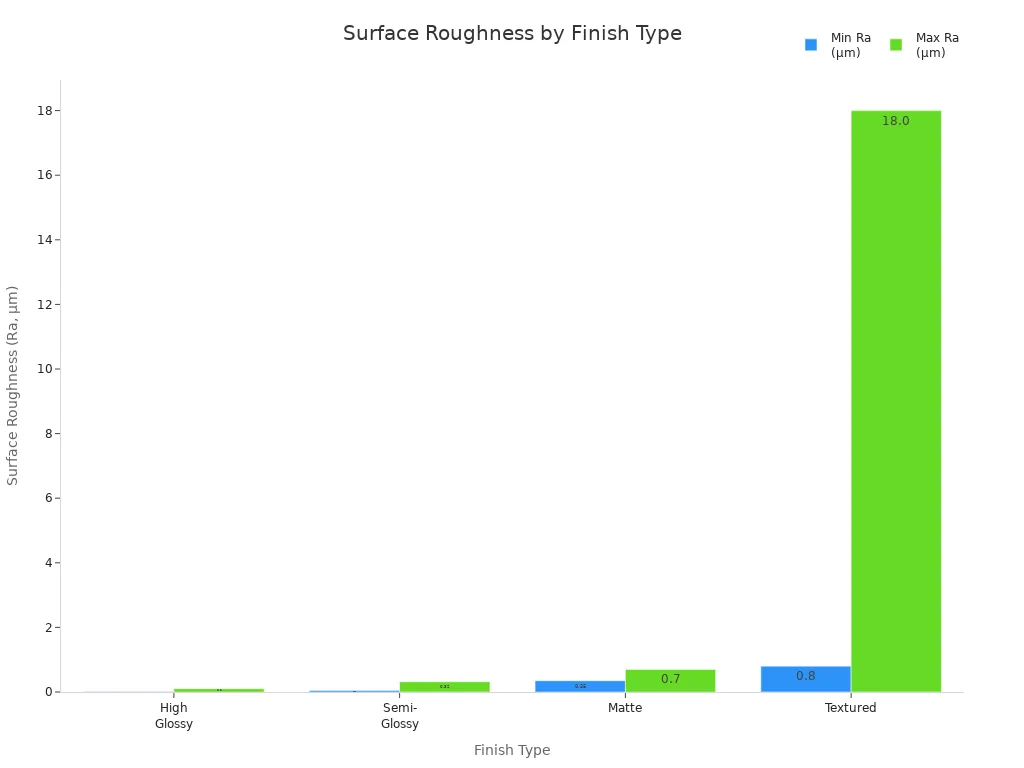
Note: The mold’s finish copies right onto the nylon part, so workers must prepare it well.
Quality Checks
Quality checks make sure nylon parts are good enough to use. First, workers review the design. They check wall thickness, ribs, and where the gates go. When setting up the mold, they look for problems like short shots, flash, or dents. They measure the size and weight. They also test if the part fits and is strong. During molding, workers watch the material and machine settings. They look for bubbles or rough spots. At the end, they test samples and write down what they find.
| Quality Control Stage | Key Checks and Methods |
| Design Review | Check design accuracy, wall thickness, ribs, gate and ejector pin placement |
| Mold and Pre-Production | Visual inspection, dimensional checks, weight measurement, functionality tests, non-destructive testing |
| In-Process Quality Control | Monitor raw material, machine parameters, check for particulates, detect defects |
| Final Inspection and Testing |
Sample testing, repair defective parts, document inspections and repairs
|
Quality checks at every step help make nylon parts strong and safe.
Best Practices and Trends
High-Quality Results
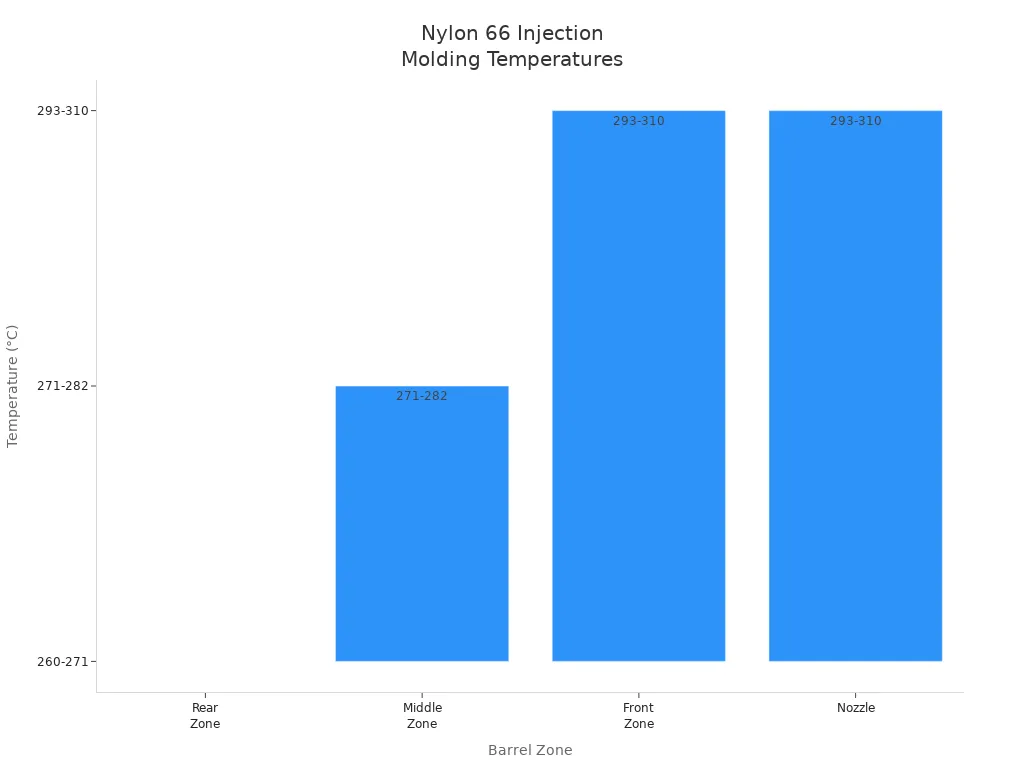
Manufacturers make good nylon parts by changing settings for each material. They pick the right heat, pressure, and speed for the nylon grade. The table below lists the best settings for Nylon 66:
| Parameter | Unfilled Nylon 66 | Impact Modified Nylon 66 | Reinforced Nylon 66 |
| Rear Zone Temp (°F) | 500-530 | 500-530 | 510-550 |
| Middle Zone Temp (°F) | 510-540 | 510-550 | 520-560 |
| Front Zone Temp (°F) | 520-550 | 520-560 | 530-580 |
| Nozzle Temp (°F) | 515-550 | 515-560 | 520-580 |
| Mold Temp (°F) | 120-220 | 120-220 | 120-220 |
| Injection Pressure (psi) | 1,000-2,000 | 1,000-2,000 | 1,000-2,000 |
Drying nylon is very important. Nylon 66 resin should be dried with special dryers at 165°F for natural colors and 180°F for black. Keeping water between 0.08% and 0.18% stops problems and keeps the part smooth.
Tip: Change the settings for each nylon type and always keep nylon dry for the best parts.
Sustainability
Nylon injection molding helps the planet in many ways:
- Using just the right amount of material means less waste.
- Factories recycle leftover plastic and packaging right there.
- Electric machines use less power than hydraulic ones.
- LED lights and rainwater systems save energy and water.
- Making everything in one place cuts down on shipping and pollution.
- Lighter nylon parts make shipping cheaper and use less energy.
Using recycled nylon is better for the earth, even if it takes more time to make. Saving energy is still the most important thing, so smart machines and good planning help a lot.
Innovations
New ideas have made nylon injection molding faster and better. Some of the best changes are:
- Changing heat, pressure, and cooling to make every part the same.
- Using computer programs to find and fix problems before making parts.
- Adding robots and smart tools (like AI and IoT) to control the process.
- Using new finishes and coatings to help molds last longer.
- Trying gas-assisted and overmolding methods to make stronger and trickier parts.
Companies that use these new ideas make better nylon parts, waste less, and lead the way in the field.
Nylon injection molding makes parts that are strong and exact if workers use the right steps. Some important things to do are: Keep wall thickness even and change it slowly to stop problems. Pick the right nylon grade for how strong the part needs to be and how much it will shrink. Dry the pellets well and watch the mold’s heat to get the same results each time. Use mold flow analysis and talk with experts to make the design better.
People can get help from Texas Injection Molding, the Plastics Innovation & Resource Center, and Xometry. In the future, nylon molding will use smarter machines and be better for the planet.
FAQ
What makes nylon different from other plastics in injection molding?
Nylon takes in water from the air. It also melts at hotter temperatures than many plastics. Because of this, workers must dry nylon and watch the heat closely. Nylon is strong and tough, so it can take the place of metal in some parts. It also does not wear out quickly.
How long should nylon pellets dry before molding?
Most nylon pellets need to dry for 4 to 8 hours. The drying temperature should be between 80°C and 120°C. Workers check the water level to keep it under 0.2%. Drying nylon well stops bubbles and weak spots in the finished part.
Can recycled nylon be used in injection molding?
Yes, factories can use recycled nylon to make parts. They must keep it clean and dry. Recycled nylon might look a little different or be a bit weaker. But it still works for many uses.
Why do nylon parts sometimes shrink after molding?
Nylon gets smaller as it cools down. It also takes in water from the air, which can change its size. Filled nylons shrink less than plain nylon. Designers plan for shrinkage so parts fit and work right.
What industries use nylon injection molded parts most?
Car, electronics, and consumer product companies use nylon parts a lot. Nylon is strong, light, and stands up to heat. This makes it good for things like gears, covers, connectors, and fasteners.
