


Cooling systems are very important in injection molding. You need them to control how fast and even your parts cool. This step affects product quality, cycle time, and how well your work goes.
- Cooling time is about two-thirds of each injection molding cycle, so it is very important for how fast you finish jobs.
- Bad cooling can cause problems, more work, and wasted material.
Key Parameter Findings Heating/Cooling Efficiency Needed for best work and good products. Temperature Uniformity Directly changes product quality and cycle time. Product Quality Better cooling gives smoother finishes and fewer problems.
Key Takeaways
- Cooling systems help control heat during injection molding. Good cooling lowers mistakes and makes products better.
- Cooling takes up about 75% of the molding cycle. Faster cooling, if quality stays good, helps make more parts.
- Even cooling stops problems like warping and sink marks. Put cooling channels close to thick spots for best results.
- Checking cooling systems often stops clogs and leaks. This helps the machines work well and makes molds last longer.
- Using new cooling ideas, like conformal cooling channels, saves energy and works faster.
Why Cooling Systems
Product Quality
You want your molded parts to look nice and work right. Cooling systems help you reach this goal. When you control cooling, you get fewer defects and less waste. If parts do not cool evenly, you might see problems like sink marks or warping. These problems happen when some spots cool faster than others. You can stop these issues by putting cooling lines near thick areas and keeping the temperature even.
- Common defects from bad cooling:
- Sink marks: Small dents or dips in thick spots.
- Warping: Parts bend or twist out of shape.
Tip: You can make parts better by moving gate spots and adding venting channels for good cooling.
Advanced cooling systems, like variable mold temperature tools, let you control temperature better. This means you get fewer defects, less rework, and less wasted material. You save time and money when your parts come out right the first time.
Cycle Time
You want to finish jobs fast. Cooling time is a big part of the injection molding cycle. Cooling can take up to 75% of the total cycle time. If you make cooling faster without hurting quality, you can make more parts.
Here is a simple breakdown of the cycle:
| Component | Description |
|---|---|
| td | Middle time |
| ti | Injection time |
| tc | Cooling time |
| t | Total cycle time (t = td + ti + tc) |
Cooling time often takes more than half of the total cycle. When you make this step better, you can make more parts in less time. You must balance speed and quality. If you cool too fast, you may get defects. If you cool too slow, you lose time.
Efficiency
You want your plant to work well and use less energy. Good cooling systems help you do this. Conformal cooling channels can make cycle times 10% to 57% shorter than old designs. Better temperature control means fewer defects and less rework.
| Evidence Type | Findings |
|---|---|
| Cooling Efficiency | Conformal cooling channels make cooling better and cut cycle times |
| Quality Improvement | Better temperature spread lowers warping and defects |
| Economic Impact | CCCs lower tool costs and make products work better |
New systems, like waterless cooling and liquified CO2, help you save water and energy. These systems also help the environment. When you use new cooling solutions, you get high energy savings and less harm to nature.
| Cooling System Type | Energy Efficiency | Environmental Impact |
|---|---|---|
| Thermoelectric Cooling | High | Low |
| Traditional Cooling Systems | Moderate | Moderate |
| Advanced Cooling Solutions | Very High | Minimal |
Note: Good cooling systems lower costs by cutting defects, rework, and waste. Even temperature means better parts and fewer problems.
Mold Temperature
Temperature Control
You need to keep the mold at the right temperature. This helps you make strong and smooth parts. When you control the temperature, the plastic flows better. The parts come out with the right shape and size. If the mold is too cold, the plastic might not fill all spaces. If the mold is too hot, the part can shrink or change shape. Different plastics need different mold temperatures. You can see this in the table below.
| Material Name | Recommended Mold Temperature (°C) |
|---|---|
| ABS | 50-80 |
| PP (Polypropylene) | 40-80 |
| POM (Polyoxymethylene) | 80-105 |
| PC (Polycarbonate) | 80-120 |
| PBT | 60-80 |
| PA6 (Nylon 6) | 80-120 |
| PA66 (Nylon 66) | 80-120 |
| PMMA (Acrylic) | 50-70 |
| LDPE (Low-Density Polyethylene) | 30-45 |
| HDPE (High-Density Polyethylene) | 50-80 |
| PEEK (Polyether Ether Ketone) | 170-200 |
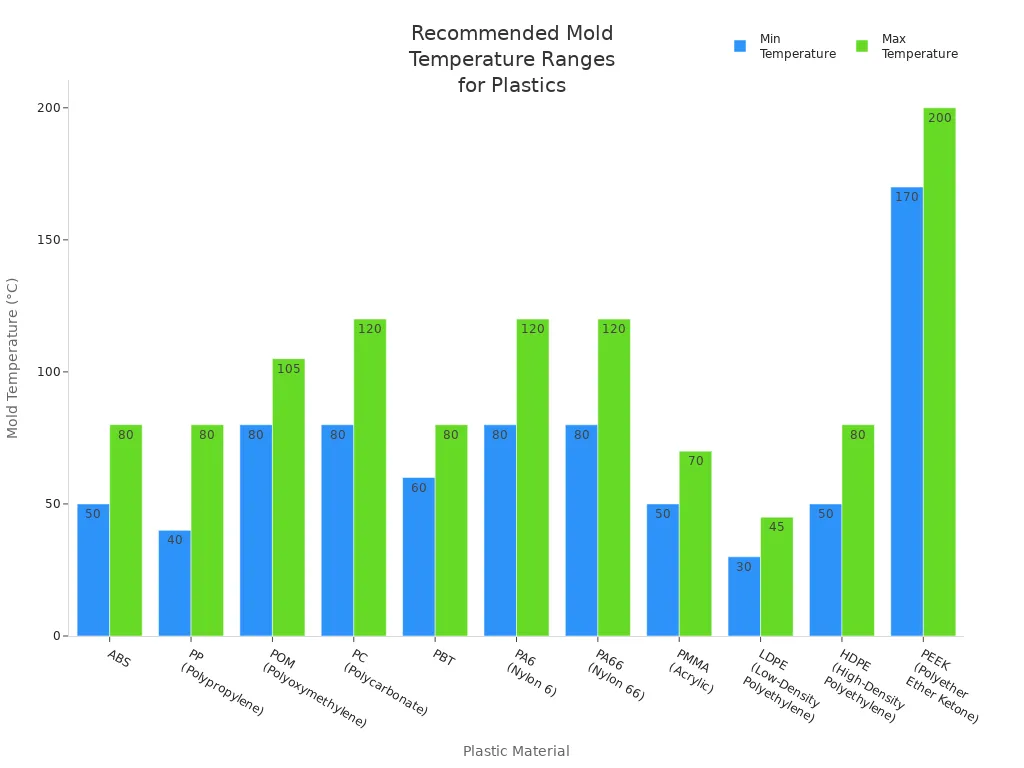
Keeping the mold at the right temperature gives you better surface quality. Your parts will also be stronger. You lower the chance of problems. Higher mold temperatures help the plastic line up better. This makes the part stronger. Lower temperatures can make weak spots.
Tip: Always check the mold temperature for your plastic before you start. This helps you avoid problems and saves time.
Even Cooling
You need even cooling so every part looks and works the same. If some areas cool faster, you may see warping or shrinking. Warped parts do not fit together well. They may also look bad. Uneven cooling can change the size of the part. This makes it hard to put pieces together.
- Problems from uneven cooling:
- Warping
- Dimensional inaccuracies
- Inconsistent surface quality
Cooling Systems that keep the temperature steady help you get better parts. The shape and size will be more correct. The part will also be stronger. The cooling rate changes how the plastic forms crystals inside. Good cooling helps the part stay strong and last longer.
Note: Even cooling helps you make parts that look good and work well every time.
Coolant Flow
Flow Rate
It is important to watch how fast the coolant moves. The right flow rate keeps the mold at one temperature. If the flow is too slow, the steel gets hotter and colder a lot. When you make the flow just a bit faster, the temperature stays the same. This helps the cooling work better.
- You need at least 1.5 GPM for good flow.
- Many people want Reynolds numbers over 4,000. Some try for 6,000-8,000.
- Fast, swirling flow lets the coolant take heat away quickly.
- You should keep the cooling channels clean. Dirt can block the flow and act like a blanket.
- Aim the coolant at the hottest parts of the mold for best cooling.
Tip: Use mold simulators to check how fast the coolant moves, how hot it is, and how hot the steel is. This helps you find problems early.
You can measure flow with special tools or by checking how much the coolant cools down as it leaves. Looking at the temperature change in the cooling circuit helps you make better molds later.
| Flow Rate (GPM) | Reynolds Number | Cooling Efficiency |
|---|---|---|
| 1.5 | 4,000+ | Good |
| 2.0 | 6,000+ | Very Good |
| 3.0 | 8,000+ | Excellent |
Distribution
You need to make sure the coolant spreads everywhere in the mold. If it does not, you get bent parts, weak spots, and rough surfaces. Even heat makes every part strong and smooth.
- Cooling should reach all parts of the mold.
- Keep the core and cavity temperatures within 5 °C of each other.
- Conformal cooling channels help you control the temperature very well.
- This new way makes jobs faster and parts better.
- Even cooling stops problems and gives a nicer finish.
Note: The way you cool the mold changes how your part hardens. If you control the spread well, you stop bending and other problems.
Conformal cooling channels are a big improvement. You get faster jobs and parts that are always the same. When you control coolant flow and spread, you work better and make great products every time.
Mold Design
Channel Layout
It is important to plan cooling channels carefully. The way you set up channels affects how heat leaves the mold. If channels are spaced evenly, cooling works better. Put channels close to thick walls because these spots get hotter. Start cooling near the sprue gate since it heats up first.
- Space channels evenly for even cooling.
- Place channels near thick walls for better cooling.
- Begin cooling at the sprue gate for best results.
- Cooling is a big part of thermal management.
- Use thermocouples to check temperature and change flow.
- Pick bigger channel diameters and add more channels to remove heat faster.
Conformal cooling channels match the mold’s shape. These channels spread heat more evenly. You get faster cycles and better parts.
A good cooling system uses channels, heat exchangers, and special inserts. Baffles and thermal pins help cool hard-to-reach mold areas.
Design Impact
How you design cooling channels changes job speed and defects. Good channel design keeps part temperature steady. This lowers cooling time and lets you make more parts. You also spend less money on each part.
| Evidence Description | Impact on Cycle Time and Defect Rates |
|---|---|
| Conformal cooling channels fix hot spots that cause warping. | You get better parts with less waste and fewer defects. |
| Cooling stage takes up most of the cycle time. | Smart design makes cooling faster and lowers total cycle time. |
| Good channel design keeps part temperature even. | Cooling time drops, so the whole cycle is shorter. |
| Shorter cycles mean you make more parts each shift. | Cost per part goes down, so production is more efficient. |
| Part thickness and material type change cooling times. | Bad cooling can make parts that bend or lose their shape. |
Always try for even cooling. This stops warping and shrinking. When you control coolant flow and temperature, parts are strong and accurate. Good mold design helps you work faster and waste less.
Coolant Quality
Properties
You have to pick the right coolant for your job. The coolant’s features change how fast heat leaves the mold. Copper alloys move heat away much faster than other metals. This makes cooling times shorter and helps you make more parts. If you use metals that do not move heat well, the mold stays hot longer. This can slow down your work and cause problems.
- Using copper alloys in molds helps cooling channels work better.
- High thermal conductivity lowers heat stress and makes molds last longer.
- Low thermal conductivity can cause bad cooling and more problems.
A study found that even thin layers of dirt inside channels slow down cooling. You should choose coolants and mold metals that stop this dirt from building up. When you use better materials, cooling works well and molds last longer.
Tip: Always check if your coolant moves heat well. This keeps your process quick and your parts strong.
Maintenance
You need to keep your coolant and channels clean and working right. Regular care helps you avoid trouble and keeps Cooling Systems running well. You should look for clogs, leaks, and rust often. If you keep flow and temperature steady, you stop heat stress and help molds last longer.
- Checking often stops clogs and leaks.
- Cleaning channels stops rust.
- Keeping flow steady stops heat damage.
- Controlling mold temperature lowers the chance of cracks.
Good cooling stops molds from getting too hot for too long. High heat can cause damage and cracks. When you control temperature, you lower cracks and help molds last longer.
| Benefit | Description |
|---|---|
| Reduced Downtime | Regular checks help stop problems that slow or stop work. |
| Extended Mold Life | Taking care of molds helps them last longer and saves money. |
| Consistent Quality | Well-kept parts make sure you get good results every time. |
| Lower Scrap Rate | Fixing problems early stops waste and bad parts. |
| Improved Efficiency | Good care helps machines work well and use less energy. |
You get fewer problems, less fixing, and less waste when you take care of your cooling system. Cooling is a big part of the injection molding cycle, so keeping it working well helps you work faster and smarter.
You help make sure the injection molding process works well. Cooling Systems help you get better parts and save time. They also help you use less energy. You can use sensors to watch for problems. AI tools can help you find issues early. These steps make your work more reliable. Try these simple ways:
| Method | Benefit |
|---|---|
| Watch temperature | Control cooling better |
| Use CFD simulations | Make channel layout better |
| Do regular maintenance | Stop breakdowns |
Remember, checking and improving your cooling process gives you stronger parts and helps you save money.
FAQ
What happens if you do not maintain your cooling system?
If you skip maintenance, you may see clogs, leaks, or rust. These problems slow down cooling and cause defects. You will spend more time fixing parts and waste more material.
How do you know if your cooling channels work well?
You can check the temperature at different spots on the mold. If the numbers stay close together, your channels work well. You can also use sensors or flow meters for better results.
Can you use water as a coolant in injection molding?
Yes, you can use water. Water cools quickly and costs less than other coolants. You must keep it clean and check for leaks often. Dirty water can block channels and lower cooling power.
Why do thicker parts need special cooling?
Thicker parts hold more heat. You need extra cooling near these spots to stop warping or sink marks. Placing channels close to thick areas helps you get even cooling and better parts.
