


You might ask if PTFE injection molding is like other plastics. You cannot use normal injection molding for PTFE. This material changes in a different way when it gets hot. Its special features make the normal process not work. If you want to shape PTFE, you must know these special problems.
Key Takeaways
- PTFE cannot be molded like most plastics. It does not melt into a liquid. Instead, it gets thick and gel-like. This means it needs special high-pressure methods.
- Regular injection molding machines cannot work with PTFE. PTFE has a very high melting point. It also does not flow well. You need special machines for PTFE. These machines must resist heat and chemicals.
- Safety is very important when using PTFE. If PTFE gets too hot, it can make dangerous gases. Always use good airflow and wear safety gear.
- Compression molding and paste extrusion are common ways to shape PTFE. These methods make strong parts. They are used in aerospace and medical fields.
- PTFE parts need extra steps after molding. They need sintering and careful cooling. This helps them become strong and stable. You must be patient and control the process closely.
PTFE Properties
High Melt Viscosity
PTFE acts very different from most plastics. It has a much higher melt viscosity than plastics like polyethylene or polypropylene. This means PTFE does not flow well when it gets hot. Its molecules are stiff and do not bend easily. Polyethylene and polypropylene have soft chains, so they melt and move fast. PTFE has heavy chains that get tangled up. This makes it even harder to shape. You cannot push PTFE through a mold like other plastics. Because of this, normal injection molding does not work for PTFE.
Tip: If you try to make PTFE flow like other plastics, you could break your machine or get bad parts.
Gel-Like State When Heated
When PTFE gets to about 350°C, it does not turn into a liquid. Instead, it becomes thick and gel-like. You can press PTFE into a mold with high pressure to make shapes. This helps you create detailed parts without much cutting. But this gel-like state is tricky. PTFE parts might try to go back to their old shape if you heat them again. High heat and pressure can also make the part change size later. You need to think about these things when you design PTFE products.
Comparison to Other Plastics
You can see how PTFE is different from other strong plastics in the table below:
| Property | PTFE | PVDF | PEEK | PAI (Torlon®) |
| Melting Point (°C) | 325–335 | ~177 | 340 | 275 |
| Continuous Use Temp (°C) | ~288 | 150 | 249 | 200–220 |
| Tensile Strength (MPa) | ~20.7 | 40–50 | ~110.3 | 138 |
| Hardness | ~60 (R) | — | 126 (R) | 90 (Shore D) |
| Processability | Sintering | Injection | Injection | Injection |
PTFE is special because it can handle high heat and strong chemicals. But it is not as strong as some other plastics. It also cannot be injection molded in the usual way. Plastics like PEEK and PAI are stronger and easier to mold. You should pick PTFE if you need it to resist heat and chemicals, but not if you need high strength.
PTFE Injection Molding Challenges
High Melting Point
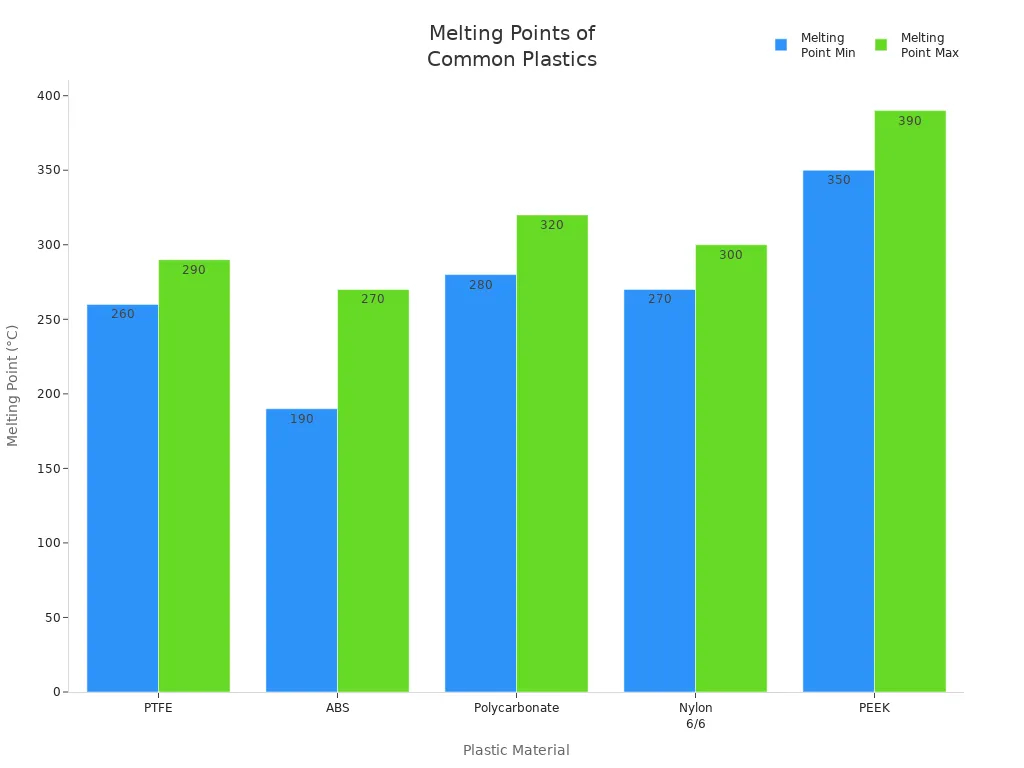
PTFE is hard to mold because it melts at a very high temperature. Its melting point is between 325°C and 347°C. This is much hotter than plastics like ABS, Nylon 6/6, or Polycarbonate. Most regular injection molding machines cannot get this hot or stay safe at these temperatures. If you use normal machines, you might break them or get bad parts.
Here is a table that shows how hot different plastics melt:
| Plastic Material | Melting Point Range (°C) |
| PTFE (Polytetrafluoroethylene) | 325 – 347 |
| ABS (Acrylonitrile Butadiene Styrene) | 190 – 270 |
| Polycarbonate | 280 – 320 |
| Nylon 6/6 | 270 – 300 |
| PEEK | 350 – 390 |
You can see the differences in this chart:
Because PTFE needs so much heat, you need special machines. These machines must be made from materials that can handle the heat and chemicals. Regular machines usually cannot do this.
Note: PTFE injection molding needs careful temperature control. If PTFE gets too hot, it can break down and make dangerous gases.
Poor Flow and Mold Filling
PTFE does not move like other plastics when it is hot. Even when it melts, PTFE stays thick and sticky. It never turns into a real liquid. When you try to fill a mold, PTFE does not move into small spaces easily. This makes it tough to make detailed shapes with PTFE injection molding.
- PTFE powder acts more like flour than melted plastic. It sticks together and does not flow well.
- You need very high pressure, sometimes up to 3000 PSI, to push PTFE into a mold.
- After pressing, the PTFE part is weak and must be handled gently.
- Sintering, or baking at high heat, is needed to make the part strong.
Because PTFE does not flow well, you cannot use normal injection molding. You need special ways and tools to get good PTFE parts.
Tooling Wear
Working with PTFE at high heat is hard on your machines. PTFE can let out fluorine gas and other chemicals when it is hot. These chemicals can hurt metal parts inside your molding machine. You need to use special metals like Inconel or Hastelloy for parts that touch PTFE. If you use regular steel, it will wear out fast or even break.
- High heat and chemicals can damage barrels, screws, and molds.
- You must check your machines often for signs of damage or rust.
- Using the wrong metals can cause expensive repairs or unsafe problems.
Risk of Decomposition
PTFE starts to break down if it gets too hot. This can happen above 350°C and gets worse at higher heat. When PTFE breaks down, it lets out gases like tetrafluoroethylene and other fluorinated chemicals. These gases are poisonous and can hurt people or the environment.
Warning: Always use good airflow and wear safety gear when working with PTFE at high heat. Dangerous fumes can build up fast if you are not careful.
Here are some safety steps you should follow:
- Wear gloves, goggles, and protective clothes.
- Make sure your work area has strong airflow.
- Teach everyone what to do in an emergency and have safety gear ready.
- Know the safe heat limits for PTFE.
- Check your machines often for leaks or damage.
- Follow all safety rules and standards.
If you do not watch the temperature closely during PTFE injection molding, you could release harmful chemicals. This is why safety is very important when working with PTFE.
PTFE Injection Molding Methods
Specialized Equipment
You cannot use normal plastic molding machines for PTFE injection molding. PTFE needs much more pressure and heat than most plastics. Special machines help you work with these hard conditions. These machines use strong metals that do not get damaged by heat or chemicals. They also have controls to keep the temperature safe and steady.
Here is a table that shows how special PTFE machines are different from regular ones:
| Equipment Type | Pressure Range | Temperature Range |
| Specialized PTFE Molding | 10 to 100 MPa (compression pressure at room temperature) | 360°C to 380°C (sintering temperature) |
| Standard Injection Molding | Lower pressures typical for thermoplastics | Lower temperature ranges |
Special PTFE machines often have:
- Molds that keep the right temperature
- Systems that push powder with high pressure
- Ovens that heat parts by themselves
- Chambers with special air or no air for safety
Tip: Always make sure your machine can handle the high heat and pressure before you start PTFE injection molding.
Modified Injection Molding
You cannot melt PTFE and inject it like other plastics. Instead, you use a different process that fits PTFE’s special needs. Here are some ways this process is different:
- You start with PTFE powder, not small pellets.
- You press the powder into shape at room temperature with high pressure.
- You take out the shaped part, called a “green” part, from the mold.
- You heat the part in a furnace to make it solid. This is called sintering.
Some machines have special things to help with this:
- Molds that keep the powder at the right temperature
- High-pressure systems to fill every part of the mold
- Ovens that heat the parts evenly
- Chambers with special air or no air to keep things safe
You can also use PTFE with fillers like glass, carbon, or graphite. These fillers help the powder move better and make the part stronger. Some companies use other fluoropolymers, like PFA or FEP, which you can mold with normal machines.
Note: Even with these changes, PTFE injection molding still has problems. You might see shrinking, bending, or cracks if you do not control the process well.
Pre-Sintering and Post-Processing
PTFE injection molding does not stop when you take the part out of the mold. You must do more steps to make sure your part is strong and works right. Here is a simple list of what you need to do:
- Drying: Take water out of the PTFE powder. Water can make bubbles or weak spots when you heat it.
- Material Preparation: Mix and weigh the powder to get the right amount for each part.
- Pressing: Put the powder in the mold and press it into shape with high pressure.
- Sintering: Heat the pressed part in a furnace at 360–380°C. This step makes the powder stick together into a solid piece.
- Controlled Cooling: Let the part cool slowly in the mold. If you cool it too fast, it can crack or bend.
- Finishing: Sometimes you need to cut or polish the part to get the right size or surface.
Safety Alert: PTFE can let out harmful gases if it gets too hot. Always use good airflow and wear safety gear when you heat PTFE.
You may see that PTFE injection molding takes more time and care than regular plastic molding. Every step is important if you want strong, good parts.
Alternative Methods
Compression Molding
Compression molding is the main way to shape PTFE. First, you put PTFE powder into a mold. Then, you press it with high pressure. The powder turns into a solid part. Next, you heat the part in a furnace. This step is called sintering. Sintering makes the part strong and dense. Many companies use compression molding for custom parts. These parts include seals, gaskets, and bearings. You can find this method in aerospace, cars, and medical tools.
Tip: Compression molding makes parts strong and good against chemicals.
Paste Extrusion
Paste extrusion helps make long, thin PTFE shapes. You mix PTFE powder with a lubricant. Then, you push the mix through a die. This shapes the PTFE into tubes or rods. After that, you remove the lubricant. Then, you heat the part at high temperatures. Paste extrusion does not use melt flow like injection molding. It uses pressure and careful heat control.
| Process Parameter | PTFE Paste Extrusion | Injection Molding |
| Material Form | PTFE powder + lubricant (16–25%) | Melted polymer (not possible for PTFE) |
| Temperature Range | >19°C for fibrillation, sintering at 330–360°C | >342°C (not feasible for PTFE) |
| Processing Mechanism | Mechanical shearing, no melt flow | Melt flow (not feasible for PTFE) |
| Post-Processing | Sintering to remove lubricant | Not applicable for PTFE |
Paste extrusion is used for PTFE tubes, wire coatings, and hoses.
Isostatic Molding
Isostatic molding makes PTFE parts strong and without pores. You put PTFE powder in a soft mold. Then, you press it from all sides. This gives the part even density and good strength. You can make big or tricky shapes like valve seats and gaskets. After molding, you heat the part to finish it.
| Aspect | Isostatic Molding | Injection Molding |
| Mechanical Properties | Uniform density, high strength | Not suitable for PTFE |
| Suitable Part Types | Large, intricate components | Complex shapes (not feasible for PTFE) |
| Production Efficiency | More time-consuming, needs sintering | Fast cycles (not for PTFE |
Pros and Cons
Think about the pros and cons before picking a PTFE method.
Pros:
- Compression and isostatic molding make strong, custom parts.
- Paste extrusion makes long, bendy shapes.
- These ways work for many fields like aerospace, electronics, and medical.
Cons:
- These methods take longer than injection molding.
- You need extra steps like sintering and cutting.
- PTFE processing uses lots of energy and makes waste that does not break down.
Note: PTFE parts are used in valves, gears, seals, and medical tools because they resist chemicals and heat.
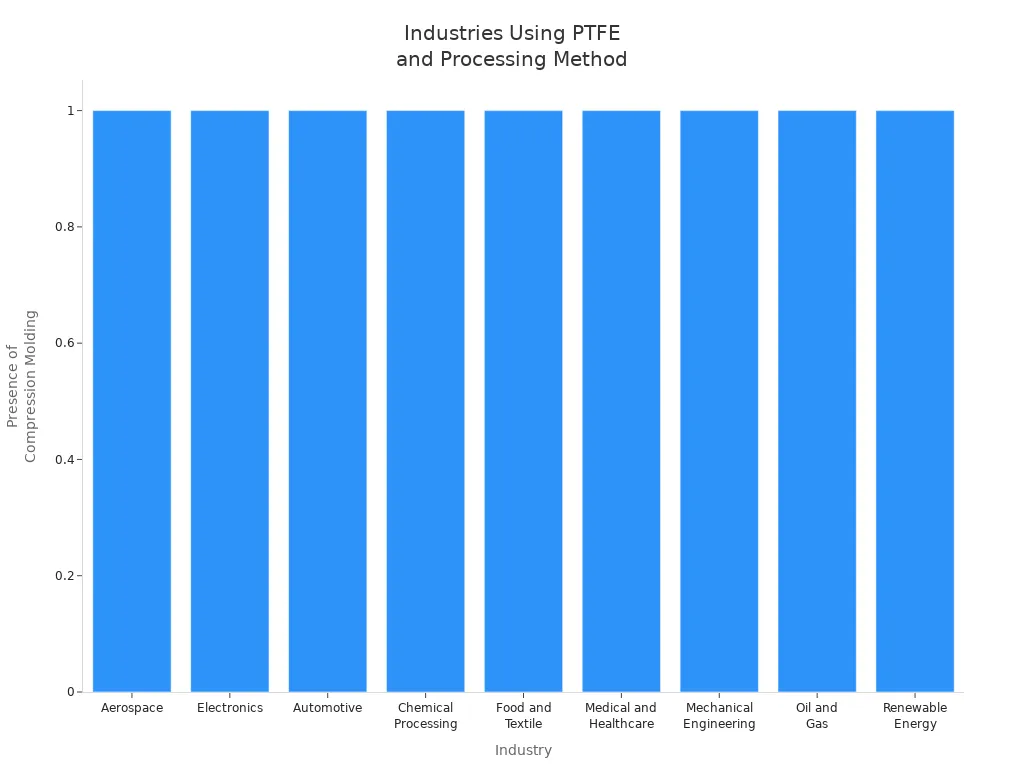
Most industries pick compression molding for PTFE. This way gives the best mix of performance and flexibility for custom parts.
You can mold PTFE, but it is very hard to do. Most companies use compression molding or extrusion instead. These ways work better and are safer. If you need to make tricky PTFE parts, follow these tips:
- Pick sharp carbide tools and go slow to stop tool damage.
- Keep the part cool and use fans or vents for safety.
- Change your design to handle PTFE’s creep and how it grows with heat.
- Use CNC machining if you need parts that fit very well every time.
Talking to PTFE experts can help you get the best results for your work.
FAQ
Can you injection mold PTFE at home?
You cannot injection mold PTFE at home. PTFE needs very high heat and pressure. Special machines and safety gear are required. Home tools cannot handle these conditions safely.
Why does PTFE need sintering after molding?
PTFE powder does not melt and flow like other plastics. Sintering heats the shaped part so the powder bonds together. This step makes your PTFE part strong and solid.
What happens if PTFE gets too hot?
If PTFE gets too hot, it can break down and release dangerous gases. You must control the temperature and use good ventilation to stay safe.
Are there safer plastics to injection mold?
You can use plastics like PEEK, PVDF, or PAI. These materials work with standard injection molding machines. They do not need special safety steps like PTFE.
What parts are best made with compression molding?
- Seals
- Gaskets
- Bushings
- Bearings
Compression molding works well for these PTFE parts because it gives strong, custom shapes.
